
Join MIT.nano for a 3D printing tool talk with UpNano, developer of one of the world’s most advanced two photon 3D printing systems. The program will feature a technical presentation, student talks, a Q&A session, and a guided tour of the MIT.nano Digital Polymer Manufacturing Facility.
Date: February 27, 2026
Time: 10 a.m. – 1 p.m.
Location: MIT.nano, 12-0168 (Basement Open Teaching Space)
Registration is free and open to the MIT community and the general public. Coffee and lunch will be provided.
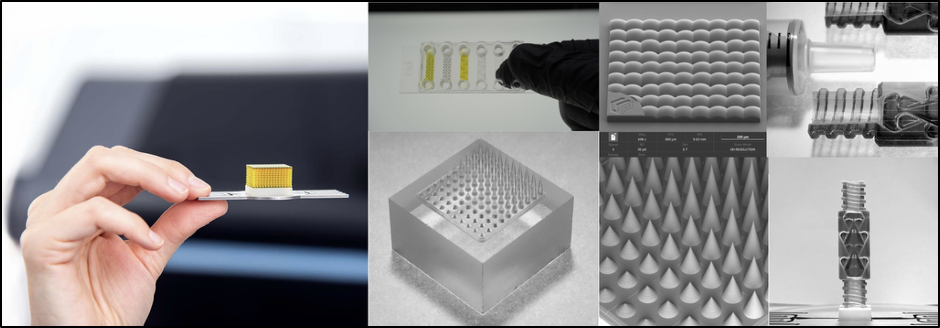
Examples of structures fabricated using the UpNano NanoOne system across multiple length scales, highlighting its precision and geometric versatility. Shown from left to right are a micro spring array, in chip microfluidic print, microneedle array, lens array, and Tesla valve structures. Images courtesy of UpNano GmbH.
Agenda
Tool Talk: Expanding the capabilities of 2PP through modular System Architecture
Speaker: Adam Murrison (UpNano, USA)
Two-photon polymerization (2PP) enables three-dimensional structures with sub-micrometer precision and exceptional geometric freedom, but its broader adoption has historically been limited by speed, scalability, and system flexibility. Recent advances in high-speed, large-area 2PP are expanding what is possible, opening new opportunities for both application-driven research and production-relevant manufacturing. This talk will introduce the NanoOne platform and demonstrate how its modular, open system architecture supports diverse workflows, novel materials, and cross-domain applications. By lowering barriers between experimentation, application development, and scalable fabrication, the NanoOne is helping position 2PP as an increasingly integrated tool for both research and manufacturing, enabling a wide range of emerging micro- and mesoscale applications.
Biography: Adam Murrison is the Head of Application Science for UpNano US Inc., leading the technical team that supports U.S. academic institutions conducting high-impact research and industry partners driving production on the NanoOne printing platform. He approaches additive manufacturing with the view that the field is inherently application- and part-dependent, and that bridging technologies is essential to developing robust, scalable solutions that meet real-world needs.
Adam’s background spans academic research and industrial implementation, guided by the process-structure-properties-performance (PSPP) paradigm. His perspective is not limited by technology, material, feedstock, or scale. He has worked across systems utilizing powders, resins, and filament feedstocks; with plastics, ceramics, and metals at a range of part sizes and resolutions. This breadth enables him to evaluate applications holistically and identify opportunities to leverage multiple technologies effectively. This approach allows Adam to translate advanced additive methods into functional, production-ready solutions while driving the development of new applications and expanding the boundaries of what’s possible in the field.
Students Presentations
Ultrasound responsive metamaterials for intelligent drug delivery systems
Aastha Shah and Yoonsoo Shin; Conformable Decoders Group, MIT Media Lab
Abstract: The success of in vitro fertilization (IVF) treatments hinge critically on mimicking the body’s naturally adaptive hormonal balance during conception to ensure successful oocyte retrieval and embryo implantation. Female hormone replacement and supplementation therapies rely on repeated blood tests followed by passive administration through intramuscular injections, transdermal patches, and vaginal suppositories, with closed loop timelines on the order of days that far exceed the optimal embryo implantation window (12h), resulting in failed pregnancies and excessive healthcare spending. Ultrasound mediated drug delivery enables safe, on demand release of small molecule therapeutics with minute scale spatiotemporal control, and we are developing a soft, remotely actuated metamaterial for localized progesterone delivery within the uterine cavity that uses a micro 3D printed trapped air bubble resonator scaffold to generate localized acoustic streaming at low ultrasound intensities, accelerating drug transport from a laminated PLGA based progesterone hydrogel for painless, repeatable hormone release without systemic exposure, with a bioresorbable device that can remain stably implanted for up to 30 days, spanning an entire IVF cycle. Beyond IVF, this platform establishes a generalizable interface for continuous, localized therapy in the female pelvis—an anatomical and physiological space that remains under-instrumented and poorly understood.
Biographies: Yoonsoo Shin is a postdoctoral researcher in Prof. Canan Dagdeviren’s group at the MIT Media Lab, where he works on soft-material–based biomedical devices. His research focuses on designing functional hydrogels and elastomeric systems for bioelectronic interfaces and ultrasound-driven therapeutic platforms.
Aastha Shah is a PhD student in Prof. Canan Dagdeviren’s group at the MIT Media Lab. Her research interests lie in exploring the physical nature of sound and its interaction with the human body. Ultrasound (US) has long been used in applications for sensing and imaging, while its capacity for actuation has been under-explored. Aastha's research seeks to harness both the wave and inertial nature of sound for frequency-specific actuation patterns.
Electrospray thrusters for CubeSat
Catherine Nachtigal; Space Propulsion Lab, AeroAstro, MIT
Abstract: Electrospray thrusters (ESTs) are compact, scalable propulsion systems for CubeSat and other small spacecraft missions. These thrusters operate by drawing propellant to a small emission site, known as the emitter, which is often an internally or externally wetted tip or capillary feature. A high voltage is applied to the propellant with respect to a grounded downstream extractor grid, allowing the propellant to be accelerated, generating thrust. Highest fuel efficiency is achieved in the pure ion regime (PIR), which requires low flow rates and precise emitter geometry, so practical thrust typically demands large, dense emitter arrays. PIR EST emitters are often fabricated as porous tips using etching or machining, resulting in poor tip quality. Coupled with the single, manually aligned extractor grid, this results in lower thruster efficiencies and increased thruster failures due to electrical shortages between the emitters and extractor grid. This work demonstrates a new EST architecture using 2 photon polymerization (2PP) fabricated emitter capillaries with integrated, individualized, fuse connected extractors to improve firing, reduce shorts, and prevent short propagation. The approach enables much denser arrays, achieving 25 times the thrust density of conventional ESTs, and supports multi hour stable emission with a plume half angle of about 15 degrees and a start up voltage near 400 V.
Biography: Catherine (Cat) is a NASA NSTGRO fellow and Ph.D. candidate in the Space Propulsion Lab in the AeroAstro department. She is from Chatham, NJ and received her B.S. in mechanical engineering from Rutgers University in 2022 before joining SPL in Fall 2022. Her doctoral research focuses on the design, fabrication, and testing of a novel “pixel” electrospray thruster aimed to increase thruster lifetime and reliability.
Mesoscale bistable flexures for biohybrid robotics
Ronald Heisser (MechE, MIT)
Abstract: Engineered muscle tissues have potential to enable highly dexterous robotic actuation at the mm-scale and beyond. Given difficulties of material interfacing and the low stiffnesses of living tissue, current biohybrid research features muscle as simple swimming or crawling demonstrations. Using the UpNano, we are able to generate geometries to fabricate flexures large enough to interface with our muscle actuators and soft enough to enable reversible bistable actuation, extending the capabilities of biohybrid systems to operate binary systems, potentially useful for robotics, microfluidics, and computing.
Biography: Ronald Heisser is a postdoctoral researcher working under Ritu Raman in the Department of Mechanical Engineering at MIT. He works at the intersection of materials, design, and manufacturing at the mm-scale to develop concepts for bio-inspired actuation. He graduated from MIT in 2016, studying Course 2 and 24-1, and earned his PhD in Theoretical and Applied Mechanics from Cornell University.
For questions or presentation proposals, please contact:
Elijah Shirman (MIT.nano) - shirman@mit.edu
Haden Quinlan (MIT APT and INM) - hquinlan@mit.edu