
The Dennis Grimard Distinguished User Award recognizes MIT.nano facility users who go beyond standard expectations to meaningfully improve the facility and the broader user community through their actions.
This award is named in honor of Dennis Grimard, whose leadership as the founding Managing Director of MIT.nano established the culture of collaboration, service, and community stewardship. The award honors users who are recognized by MIT.nano staff members to embody the same commitment to our community. Submit a nomination.
Congratulations to the inaugural recipient!
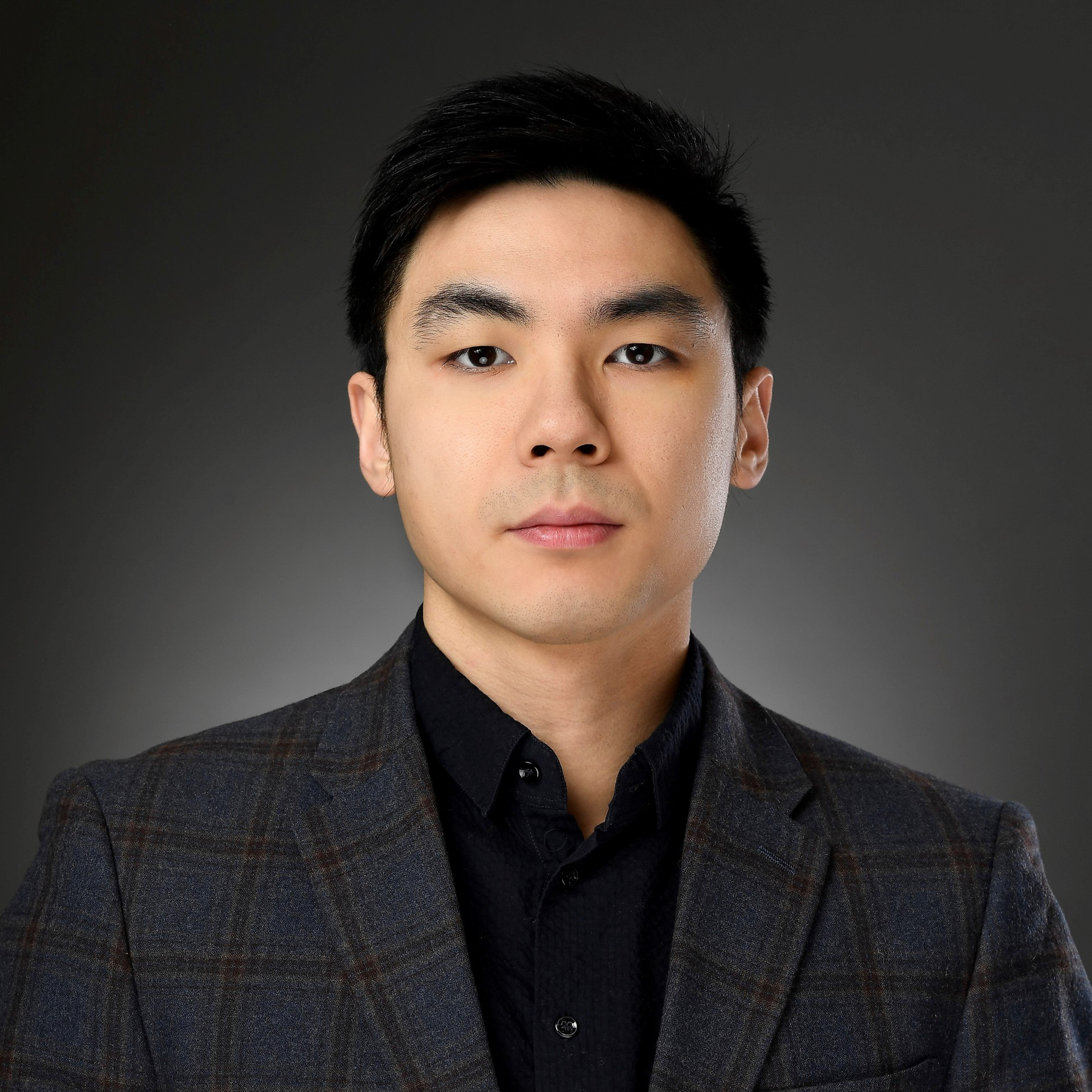 Kaidong Peng PhD ’23
Postdoctoral Associate
Quantum Coherent Electronics Group
Kaidong received his Bachelor of Science in Electrical Engineering from the University of Illinois at Urbana-Champaign in 2018 and PhD in EECS from MIT in August 2023. His undergraduate research was in integrated photonics on the design and fabrication of non-volatile switches and modulators for energy-efficient optical routing. He first joined QCE Spring 2019. He is currently working on traveling wave parametric amplifiers, isolators, and circulators for quantum computing applications.
"MIT.nano has been instrumental to our research, providing world-class fabrication, characterization, and wafer processing capabilities that gave us the capacity to explore bold ideas in parallel and rapidly iterate," says Peng. "That tight feedback loop — from idea to fabricated chip prototype — was critical to pushing performance to the limits and demonstrating proof-of-concept devices with best-in-class results, all within a reasonable timeframe."
Learn more about Kaidong, why he got into quantum, and what superpower he'd like to have in the interview below.
What are you working on?
My research focuses on quantum amplifiers, a critical component in superconducting quantum computers. Qubits, the quantum equivalent of a transistor and the building blocks of quantum computers, operate with electrical signals that are extraordinarily faint, thousands of times weaker than a typical cell phone signals - signals that would otherwise be lost in the large ambient and electronics noises without quantum amplification. Accurately reading out these signals is essential, both for performing hardware error-correction and for delivering meaningful results in applications like drug discovery or cryptography. My doctoral work utilizes new design ideas and novel fabrication processes to make these amplifiers not only extremely precise, but also very hardware-efficient or scalable.
How could your research advance the field of quantum computing?
With traditional resonant amplifiers, an entire hardware chain is dedicated to reading out only one or a few qubits. Such one-to-one hardware scaling is infeasible for useful large-scale quantum computers with thousands to millions of qubits. The quantum amplifiers we work on, called Traveling Wave Parametric Amplifiers (TWPAs), address this directly. They not only approach the theoretically optimal noise performance from quantum mechanics to deliver the signal precision quantum computers need, but also have broad operational bandwidth which allows tens to hundreds of qubits to be read out simultaneously across different frequency channels, all on a single physical wiring line. This frequency-multiplexed readout approach can reduce hardware overhead, cost, and heat load by 10 to 100X.
What first made you interested in this field?
A few things came together. I've always loved electronics, and the idea of applying concepts from optics and microwave engineering to an emerging field like quantum computing was really exciting and seemed like a great opportunity. I also clicked with my advisor, Prof. Kevin O'Brien — he was a new professor at the time, and I was his first student. I loved his advising style and the freedom he gave me, so after my first rotation I didn't feel the need to look anywhere else. Building the lab from the ground up as his first student was a unique and fun experience — challenging too, but as Kevin likes to say, “It builds character.”
Now some questions just for fun, did you always want to be an engineer?
When I was a kid, I wanted to be a basketball or soccer player.
What’s one superpower you would like to have?
Teleportation
What are you looking forward to in the future?
This is the first thing that came to mind, but if our consciousness can live forever, that would be very cool. It's like that famous quote, "I think therefore I am."
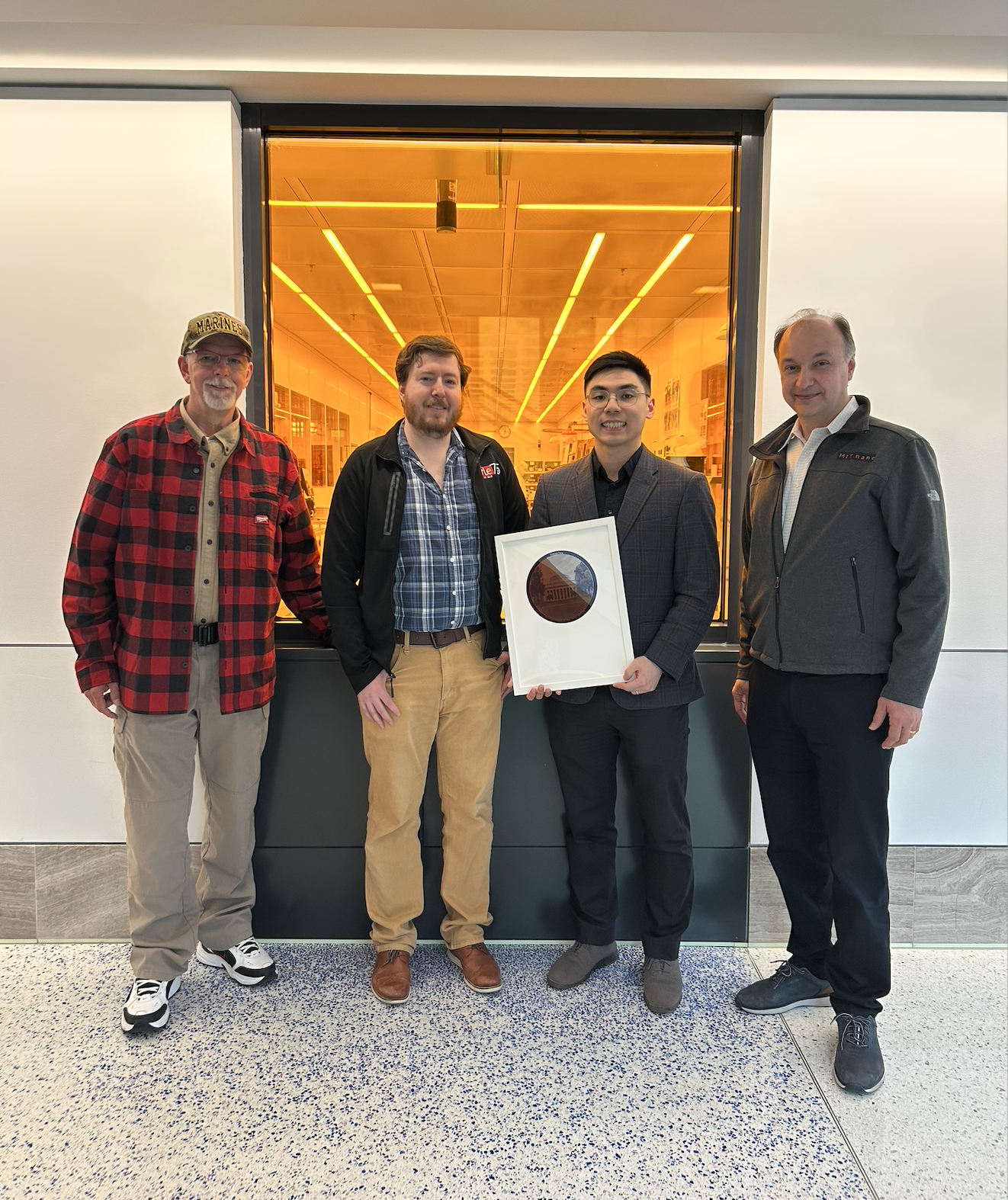
Pictured above (L-R): Dennis Grimard, Prof. Kevin O'Brien, Kaidong Peng, and MIT.nano Director Prof. Vladimir Bulović pose outside MIT.nano's cleanroom. Peng holds an 8" wafer etched with a photo of the MIT Dome and the text "Dennis Grimard Distinguished User Award, MIT.nano, April 30, 2026."