
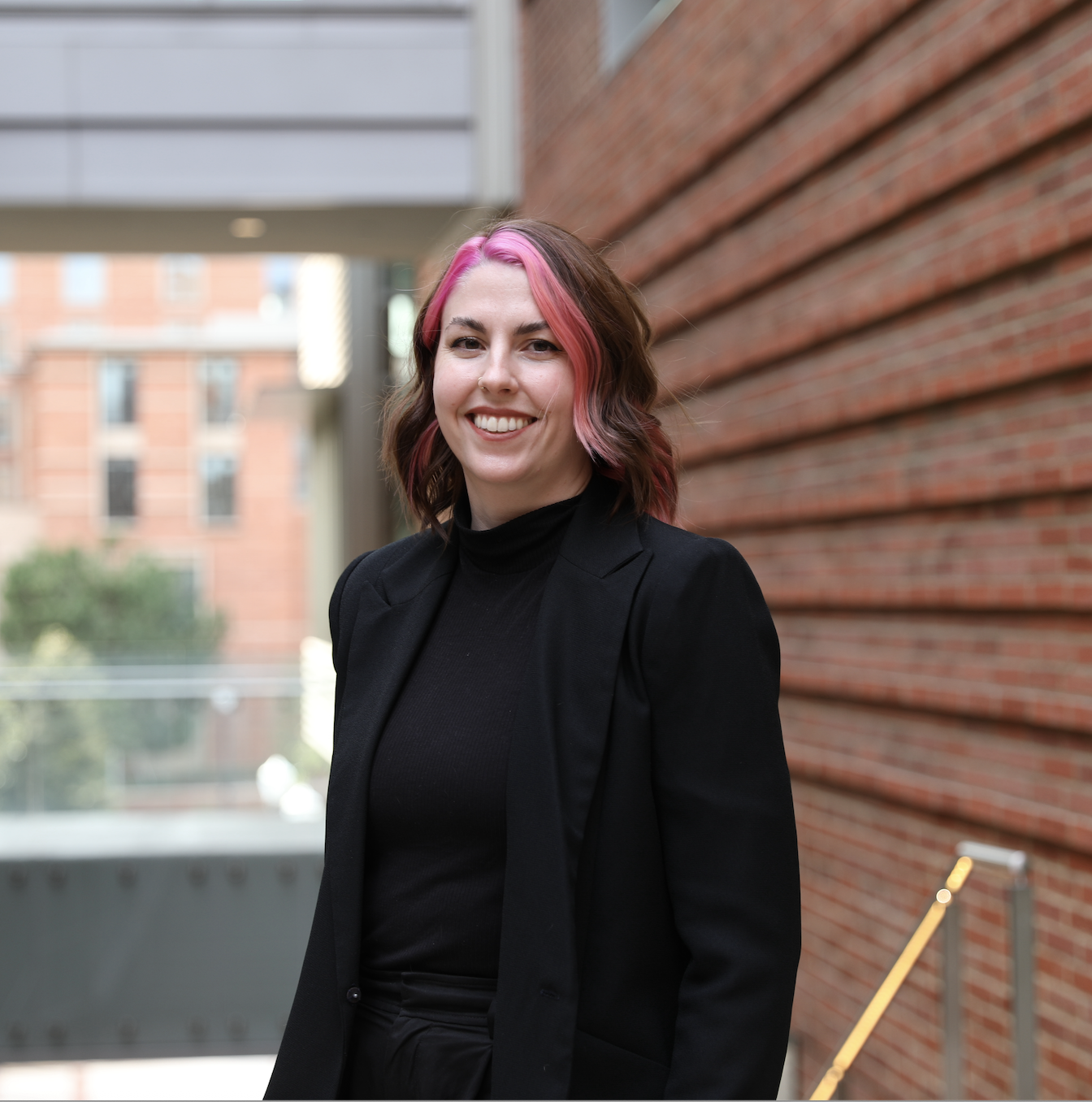
Carissa Eisler
Assistant Professor in Chemical Engineering and Biomolecular Engineering
University of California Los Angeles
Date: April 7, 2026
Time: 3:00 – 4:00 PM ET
Location: Grier 34-401B
Reception to follow.
Note: We're thrilled to be able to welcome Prof. Eisler on this new date! Her talk was originally scheduled in February when MIT was closed due to winter weather.
ABSTRACT
Next generation optoelectronic devices require extremely bright emitters with tunable properties, such as color tunability and preferential light emission angle, that can be produced at large scales. Perovskite nanocrystals (PNCs) are an excellent candidate for this challenge as they can achieve extremely high quantum yields with a wide color gamut and have demonstrated interesting quantum phenomena. Recently, the alignment electric dipoles within perovskite nanocrystal films, which governs angular light emission and energy transfer rates, was shown to be variable based on the local environment, which is unique to this class of materials.
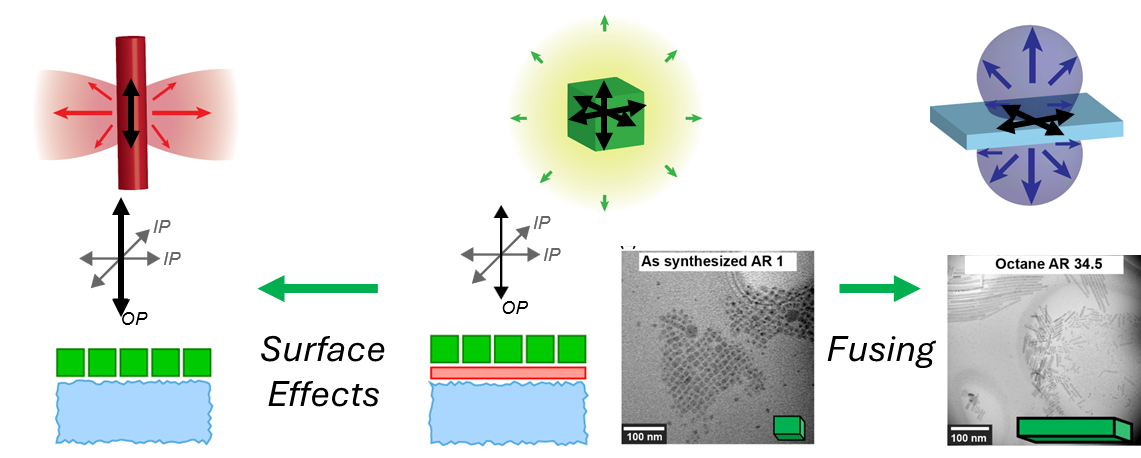
In this talk, Eisler will describe her group’s work on exploring how surface effects and neighbor interactions are affected by assembles of CsPbBr3 nanoparticles. They synthesized films of CsPbBr3 nanocrystals and used back focal plane microscopy to quantify how structure, packing, and local environment drive the electronic transition alignments.
Eisler will show how altering the substrate from glass to a soft polymer can allow us to alter the dipole alignment in the material from vertically enhanced to a more isotropic alignment without changing the local optical effects. Then, she will show how anisotropic particle fusing can exaggerate the horizontal dipole alignment and can be used to quantify degradation kinetics. Finally, Eisler will show their developments in liquid-liquid self-assembly to achieve large, low defect assemblies of perovskite nanoplates.
By optimizing the solution volume and concentration of specific ligands in the sublayer, they can achieve large areas of edge up or face down assemblies with significantly different light emission patterns. Understanding the interplay of surface chemistry and structure will elucidate why these nanocrystals can achieve extraordinary photonic properties and allow us to design materials for next generation technologies.
BIOGRAPHY
Carissa Eisler is an assistant professor in the Chemical and Biomolecular Engineering Department at UCLA. She received her B.S. in Chemical Engineering from UCLA, and her M.S. and Ph.D. with Harry Atwater from Caltech. Before coming to UCLA, she was a postdoctoral scholar with Paul Alivisatos at UC Berkeley. Prof. Eisler was the recipient of the UCLA Society of Hellman Fellows Award (2021), the Northrop Grumman Excellence in Teaching Award (2023), and the NSF Faculty Early Career Award (2023).
Prof. Eisler’s research integrates optical design, materials chemistry, and transport phenomena to understand the complex propagation of light and energy through nanostructured materials. She is passionate about teaching and mentoring the next generation of scientists and engineers who will address the interdisciplinary challenges of global energy usage and production. Outside work, she enjoys hiking, art, Dungeons&Dragons, and obsessing over her two cats, Jujubee and Louise.